Odoo is available in Dubai and across the UAE: a modular ERP with a UAE fiscal localisation (5% VAT), Arabic support and local implementation support. It suits businesses from a single freelancer to growing SMEs that need more than invoicing, such as stock, purchasing, CRM or several companies, and for mandatory e-invoicing it works with an accredited service provider (ASP). This guide covers what Odoo does here, what it costs, who it fits and when another option may suit you better.
Transparency: this site is published by Kenobiz Solutions, an Odoo partner in Dubai (about us). We use explicit criteria, and we say when another tool fits better.
Key facts
- Hundreds of companies use Odoo in the UAE, from freelancers to groups with several companies; there is no official count.
- 5% VAT is set up by Odoo's UAE localisation. Corporate Tax is 0% up to AED 375,000 of taxable income and 9% above (Cabinet Decision No. 116 of 2022).
- 31 March 2027: businesses with revenue below AED 50 million must appoint an accredited ASP, and go live on 1 July 2027.
- Two cost blocks: Odoo licences, billed per user per month, and a one-off implementation quoted by a partner.
What is Odoo?
Odoo is a modular business suite (ERP) developed by Odoo S.A. You start with the apps you need, such as accounting, invoicing, sales, purchasing, inventory, CRM, manufacturing or e-commerce, and add more later, all sharing one database. Odoo exists as a free open-source Community edition and a paid Enterprise edition, in the cloud or on your own servers.
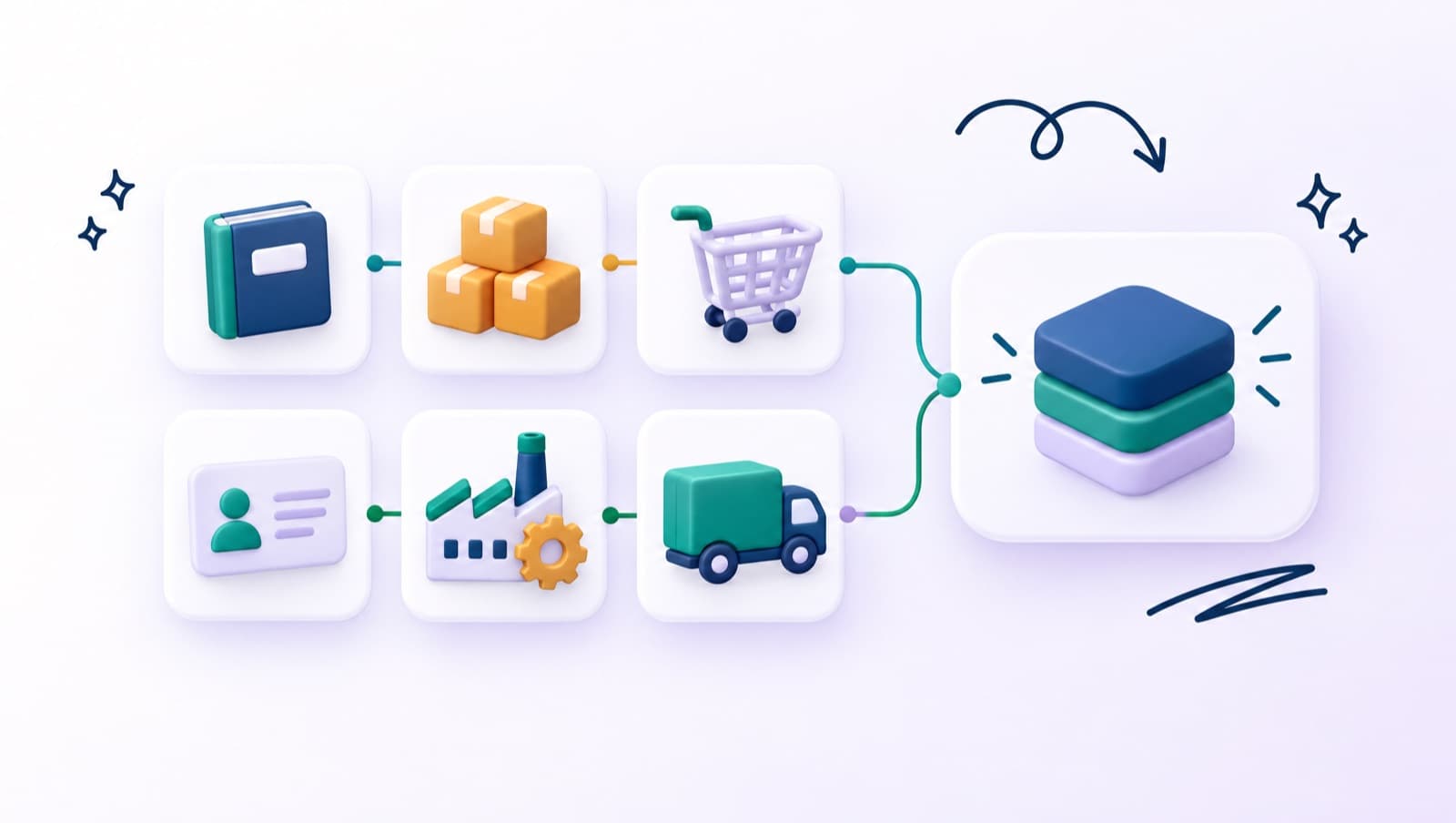
The point of an ERP is that information is typed once. A quotation becomes a sales order, then a delivery from your warehouse, then an invoice with 5% VAT, then a payment matched to your bank statement. Nobody re-keys the customer's TRN or the price into a second tool, and your accountant sees the same figures as your sales team.
That is also why Odoo is more than accounting software. If you only need to send invoices and file VAT, a lighter tool may be enough (see who Odoo fits below). If you run stock, buy from several suppliers, sell online or manage more than one company, the single database is where Odoo earns its cost.
The Community edition is open source and free to download, but it lacks some apps and features of the paid Enterprise edition, and you still pay for hosting and set-up. When this site talks about Odoo licences, it means Enterprise. Check which edition includes the apps you need before you decide.
Is Odoo available in the UAE, with VAT and Corporate Tax?
Yes. Odoo is sold and implemented in the UAE, and its UAE fiscal localisation sets up a UAE chart of accounts and 5% VAT taxes for invoices and VAT reporting. For Corporate Tax, Odoo keeps the books your return is prepared from. Check the exact UAE reports available on your version with your partner before going live.
Here is what "UAE localisation" means in practice, and where you should check details on your own version.
VAT at 5%. The localisation installs the UAE taxes and accounts so that invoices show your TRN, the VAT amount and the totals in AED. Odoo's VAT report gives you the figures for your return on EmaraTax. Ask your partner to show the report against the boxes of the current FTA return, and have your accountant check the first two returns. For the invoice format itself, see our guide to UAE e-invoicing requirements.
Corporate Tax. The UAE taxes taxable income at 0% up to AED 375,000 and 9% above. Odoo gives you the profit and loss account, balance sheet, general ledger and analytic reports that a Corporate Tax return is built from. Whether a dedicated UAE Corporate Tax report is included depends on the version, so check it in a demo. Many small companies can elect Small Business Relief, but they still need clean books.
Arabic and bilingual documents. Odoo can be used in Arabic and can print documents in the customer's language. Many UAE businesses want English and Arabic side by side on the same invoice. That is a template question: look at what your version gives by default, and ask your partner what needs adjusting.
Currencies. Odoo handles AED alongside USD, EUR, INR and other currencies, with exchange differences recorded in the books. This matters for importers and re-exporters, who often buy in one currency and sell in another.
Several companies. Many groups run a mainland company and a free zone company, or a trading arm and a services arm. Odoo's multi-company feature keeps them in one database with separate books, VAT and TRNs. Check on odoo.com which plan you need for it.
Payroll. Odoo has a payroll app, but native generation of UAE WPS salary files is not confirmed for every version. If WPS matters, ask the partner to show it working or to name the add-on they use.
Can Odoo handle UAE e-invoicing?
Odoo issues the invoices and credit notes. In the UAE, an accredited service provider (ASP) must then transmit them over the Peppol network and report the tax data to the Federal Tax Authority (FTA). An Odoo user connects to an ASP through a connector. Businesses below AED 50 million must appoint an ASP by 31 March 2027.
UAE e-invoicing is mandatory for B2B and B2G transactions. An e-invoice is a structured XML file in the PINT AE format, not a PDF: see how Peppol and PINT AE work. The rule is the same whatever software you use: your system produces the invoice data, and an ASP from the official list of accredited service providers carries it to your customer's ASP and reports it to the FTA.
For an Odoo user, that means three things:
- Your data must be complete in Odoo: customer TRNs, addresses, product descriptions, tax codes and units. The Ministry of Finance lists 51 mandatory fields for an electronic tax invoice.
- You need a connector between Odoo and your ASP. Third-party connectors are published on the Odoo Apps Store, mostly for recent versions. If you run an old version, budget an upgrade.
- You must sign with an ASP before your deadline. Businesses with revenue of AED 50 million or more must appoint one by 30 October 2026 and go live on 1 January 2027; everyone else by 31 March 2027, live on 1 July 2027. See the full UAE e-invoicing deadlines.
Missing the ASP deadline costs AED 5,000 per month or part of a month under Cabinet Decision No. 106 of 2025 (see all e-invoicing penalties). The step-by-step version for Odoo users, including what to ask an ASP, is in our guide to Odoo e-invoicing in the UAE.
Which Odoo apps are useful for UAE SMEs?
A common path is to start with Accounting or Invoicing, then add Sales, Purchase and Inventory, which trading and distribution companies need from day one. CRM, Manufacturing, Website and eCommerce come next, depending on the business. Multi-company matters for groups with mainland and free zone entities. Start small: each extra app adds set-up, training and licence cost.
| Your need | Odoo app | Typical UAE use |
|---|---|---|
| Book-keeping and VAT | Accounting / Invoicing | AED and foreign-currency invoices, 5% VAT, bank reconciliation, credit notes |
| Selling | Sales, CRM | Quotations, sales orders, pipeline follow-up, salespeople's targets |
| Buying | Purchase | Requests for quotation, purchase orders, supplier bills matched to receipts |
| Stock | Inventory | Several warehouses, deliveries, stock valuation, re-export flows |
| Producing | Manufacturing | Bills of materials, production orders, component consumption |
| Selling online | Website, eCommerce | Online shop connected to the same stock and invoices |
| Several entities | Multi-company | Mainland and free zone companies in one database, separate books and TRNs |
Two pieces of advice from projects in Dubai. First, phase the rollout: going live with accounting, sales, purchase and inventory, then adding CRM or manufacturing three months later, is safer than switching everything on in one weekend. Second, resist customising early. Standard Odoo processes are cheaper to maintain and to upgrade; change your process before you change the software, unless the difference is a real competitive advantage.
What's new in Odoo 20 for UAE companies?
Odoo 20, whose release notes were published in September 2026, brings AI agents, an offline mode and accounting changes such as stricter bank-entry rules and duplicate-invoice warnings. For the UAE, the chart of accounts was redesigned to follow IFRS and the UAE Commercial Companies Law, and payroll gains an Emiratisation report and a WPS export aligned with MoHRE.
Our page on what's new in Odoo 20 details each change, including the FTA VAT audit file, the end-of-service benefit report and what the release means for e-invoicing.
How many companies use Odoo in the UAE?
There is no official count, but hundreds of UAE companies use Odoo, from freelancers to groups with several companies. No public source measures Odoo's market share in the UAE, so be wary of anyone quoting one.
The question comes up often, including on Reddit threads asking whether Odoo is "a big name" in the UAE. Odoo is used worldwide, and its UAE localisation covers the local essentials: VAT return, Corporate Tax report, bilingual invoices and payroll with WPS files.
Two points are worth knowing:
- Vendor presence. Odoo S.A. has announced an office in Dubai South on its own blog.
- Implementation. Projects are delivered by Odoo partners; our guide to choosing an Odoo partner in the UAE lists the questions to ask.
If you already use Odoo, the e-invoicing deadline is the moment to check your version and your partner. Some companies run old versions that their original integrator no longer maintains; a connector to an ASP may require an upgrade first.
How much does Odoo cost in the UAE?
You pay two things: Odoo licences, billed by Odoo S.A. per user per month, and a one-off implementation by a partner. Odoo publishes its plans and AED prices on odoo.com/pricing. The implementation cost depends on the apps, number of users, data migration, customisation and integrations such as the ASP connector.
The licence is the predictable part: multiply the price per user per month on odoo.com by your number of users and by 12. The implementation is where budgets differ, and where a fixed quote protects you. Our Odoo pricing guide for the UAE explains each cost driver and includes an estimator that turns your project profile into a fixed-quote request.
Do not compare a licence price with a full project price. A fair comparison looks at the total cost over three years: licences, implementation, ASP fees beyond the free allowance, support and internal time. Over that horizon, a set of separate inventory, CRM and e-commerce subscriptions, plus manual re-keying between them, can end up costing more than one database. For a three-person company that only invoices, the reverse is true.
Is Odoo right for your business?
Odoo fits UAE businesses from a single user, a freelancer can start with invoicing and accounting only, up to around 200 users, as soon as you need more than invoicing (stock, purchasing, CRM, manufacturing, e-commerce or several companies) or plan to grow. It is not built for very large groups with global ERP standards.
| Odoo is usually a good fit if… | Another option may suit you better if… |
|---|---|
| You are a freelancer or a team of up to around 200 users who needs, or will need, more than invoicing | You already run an accredited tool that suits you and need nothing more |
| You need stock, purchasing, CRM, manufacturing, e-commerce or several companies | You are a large group with global ERP standards and in-house IT teams |
| You are growing and want one system rather than five tools | Your current tools work well together and are already connected to an ASP |
| You judge cost over three years, not the first month | You need software and ASP from the same vendor today, with no connector |
| You want hosting choice: cloud or your own servers | You need on-site ERP standards set by a global head office |
When staying put is the right call. If you already use an accounting tool whose vendor is an accredited ASP, such as Zoho Books (e-invoicing from its Professional plan at AED 90 per month billed annually, AED 129 monthly, per organisation, for up to 5 users, excluding VAT), and you do not plan to add stock, CRM or several companies, keeping it is a sound choice. Our Odoo vs Zoho Books comparison sets out the differences line by line.
When something bigger may be justified. Groups with thousands of users, complex global consolidation or industry-specific requirements often look at SAP, Oracle or Microsoft. If that is you, compare Odoo with them using a partner that has delivered projects of your size.
What to plan for with Odoo:
- Scope. Invoicing and accounting can be set up quickly. Each extra app (stock, manufacturing, CRM, e-commerce) adds configuration and a short training for the people who use it.
- A partner for wider projects. Once a project covers several apps, several companies or a data migration, an implementation partner handles set-up, localisation checks and the ASP connector.
- ASP status pending. See the status box above: until it changes, e-invoicing goes through a connector and a separate ASP contract.
- Upgrades. New major versions arrive regularly. Heavily customised databases cost more to upgrade, which is another reason to stay close to standard.
How do you get started with Odoo in Dubai?
List your processes and users, then see Odoo running on your own invoices before you commit. Ask for a fixed quote with a clear scope, and plan e-invoicing with an accredited ASP from the start. A free trial on odoo.com lets you explore alone first.
- Write a one-page brief. Number of users, companies and warehouses; your current tool (Excel, Tally, QuickBooks, Zoho or an old Odoo); must-have processes; your e-invoicing deadline.
- See a demo on your own data. A generic demo shows features; a demo built on three of your real invoices shows whether your VAT, credit notes and documents work. You can book an Odoo demo on your own invoices.
- Compare partners. Ask the questions in our Odoo partner checklist: UAE references, who does the work, how e-invoicing is handled, what happens after go-live.
- Get a fixed quote. Scope, timeline, data migration, training and support in writing.
- Choose your ASP early. Check that it has a working Odoo connector and that the 100 free e-invoices per year every accredited ASP must offer are in the contract.
- Migrate, train, go live, then add apps. Start with the core and extend once the team is comfortable.
- Odoo 20: what's new →What Odoo 20 changes for UAE companies: chart of accounts, VAT audit file, payroll, AI credits, e-invoicing and upgrade planning.
- Odoo e-invoicing →How an Odoo user meets the UAE e-invoicing mandate: Odoo's ASP status, what the ASP does, setup steps and costs.
- Odoo pricing →How Odoo licences are billed in the UAE, what drives implementation cost, and how to compare the total cost with Zoho Books.
- Choose an Odoo partner →10 questions to ask an Odoo partner in the UAE, red flags, pricing models and what to check for VAT and e-invoicing.
- Odoo demo →A 30-minute Odoo demo built on three of your own invoices, with UAE VAT and the e-invoicing flow.
How does Odoo compare with other software in the UAE?
Odoo competes with accounting tools such as Zoho Books, QuickBooks, Xero, Tally and Wafeq, and with ERPs such as SAP Business One, Microsoft Dynamics 365 Business Central and Oracle NetSuite. Each has a different ASP status, pricing model and ideal profile. Our comparisons set them side by side with the same criteria.
- For small companies choosing their first proper system: best accounting software in the UAE.
- For growing companies with stock, purchasing or several entities: best ERP software in the UAE.
- For a head-to-head on the most common shortlist: Odoo vs Zoho Books.
- For the e-invoicing angle only, with each vendor's official ASP status: UAE e-invoicing software compared.
Not sure where you stand? The two-minute readiness check gives you your phase, your deadlines and a software recommendation, even if it is not Odoo. You can also read the full UAE e-invoicing guide first.
Odoo is a trademark of Odoo S.A.
Frequently asked questions
What does the Odoo company do?
Odoo S.A. develops and sells Odoo, a suite of business applications (ERP): accounting, invoicing, sales, purchasing, inventory, CRM, manufacturing, website and e-commerce. It sells Enterprise subscriptions directly and through partners. In the UAE, projects are usually set up by an Odoo partner.
Does Odoo have an office in Dubai?
Odoo S.A. announced an office in Dubai South on its own blog. Day-to-day implementation, training and support for UAE companies are provided by Odoo partners based in the UAE.
Can I use Odoo in Arabic?
Yes. Odoo can be used in Arabic, and documents such as invoices can be printed in Arabic. If you want English and Arabic side by side on the same invoice, check the standard template of your version in a demo; adjusting the layout is a common, small task for a partner.
Can Odoo prepare my UAE VAT return?
Odoo's UAE localisation sets up 5% VAT and provides VAT reporting that you use to prepare your return on EmaraTax. Check that the report matches the boxes of the current FTA return on your Odoo version, and have your accountant review the first returns.
Is Odoo ready for UAE e-invoicing?
Odoo issues invoices and credit notes; an accredited service provider transmits them over Peppol and reports them to the FTA. Odoo connects to an accredited ASP through a connector. Odoo's own ASP status is shown on our Odoo e-invoicing page and updated on the day the official list changes.
Is Odoo good for small businesses in the UAE?
Yes. Odoo works from a single user: a freelancer or a small business can start with invoicing and accounting only, then add CRM, stock or e-commerce in the same database as needs grow. If you already use an accredited tool that suits you, such as Zoho Books, and need nothing more, staying with it is also a sound choice.
How do I find an Odoo partner in Dubai?
Look for real UAE VAT and e-invoicing experience in your industry, ask for a demo on your own invoices and a written quote with a clear scope. Our partner guide lists the 10 questions to ask before you sign.
See Odoo on your own invoices
A 30-minute demo with an Odoo partner in Dubai, in English or French — using your real invoice examples.
Book from your phone
Related guides
- Choose an Odoo partner10 questions to ask an Odoo partner in the UAE, red flags, pricing models and what to check for VAT and e-invoicing.
- Odoo e-invoicingHow an Odoo user meets the UAE e-invoicing mandate: Odoo's ASP status, what the ASP does, setup steps and costs.
- Odoo 20: what's newWhat Odoo 20 changes for UAE companies: chart of accounts, VAT audit file, payroll, AI credits, e-invoicing and upgrade planning.
- Odoo pricingHow Odoo licences are billed in the UAE, what drives implementation cost, and how to compare the total cost with Zoho Books.
Sources
Official texts and references used for this page:
- Odoo documentation — United Arab Emirates fiscal localisation — consulted 2026-10-10
- Odoo blog — Odoo expands presence in the Middle East with new Dubai South office — consulted 2026-10-10
- Ministry of Finance — list of accredited e-invoicing service providers (ASPs) — consulted 2026-10-10
- Ministerial Decision No. 244 of 2025 — e-invoicing implementation phases (MoF) — 2025
- Ministerial Decision No. 66 of 2026 — amends Decision No. 244 of 2025 (MoF) — 2026
- MoF — Corporate Tax 0% threshold of AED 375,000 (Cabinet Decision No. 116 of 2022) — 2023
- Zoho Books UAE pricing (AED) — consulted 2026-10-10
Last reviewed: By Kenobiz Solutions editorial team
General information, not tax or legal advice. For your specific case, consult an FTA-registered tax agent.